Trending

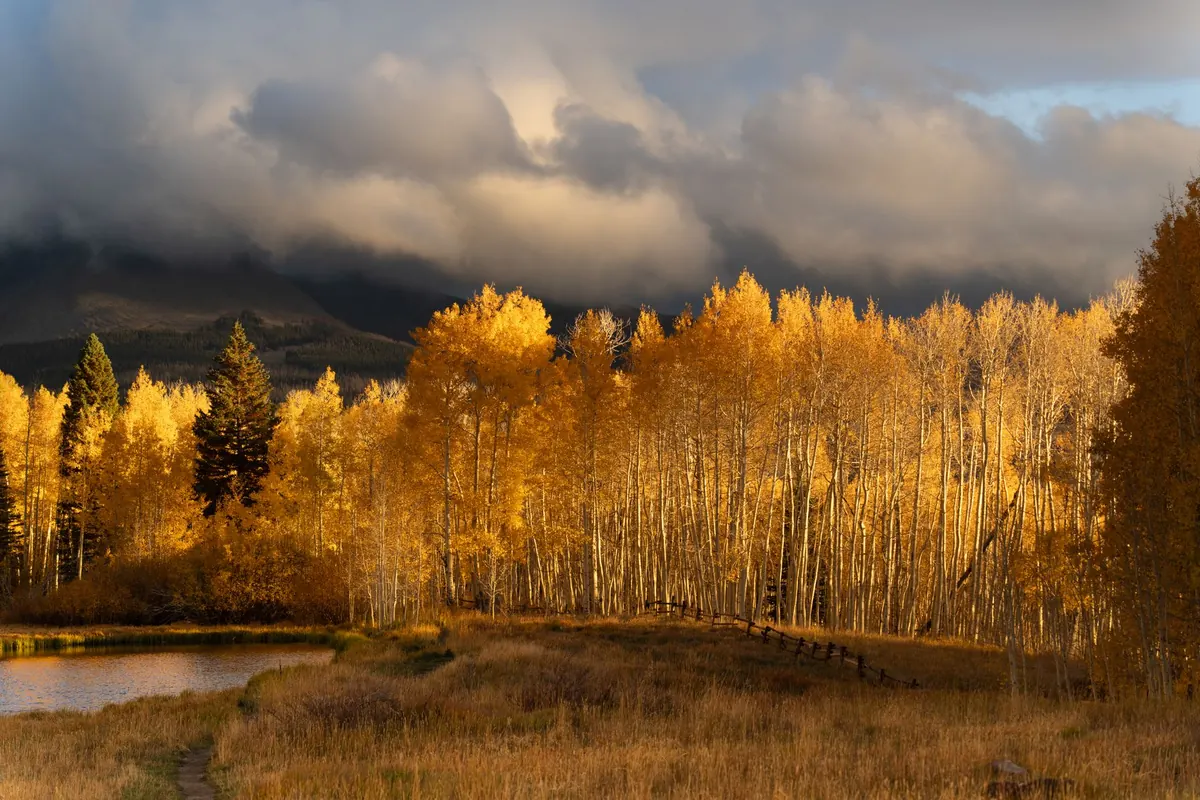
Autumn in Aspen is short and punctual. Sometime in the third week of September the high slopes above town begin to turn, and by the first days of October the valleys are full of gold. Miss the window and you are looking at bare grey branches against fresh snow. The advantage is that the colour moves downhill in a fairly predictable way, so you can follow it: high country first, lower valleys a fortnight later. What follows is how to time it, where to stand, and which roads and trails to build a day around.
The trees that give the town its name are quaking aspens, and they turn gold — occasionally orange, rarely red. Each grove is a clone: thousands of trunks sharing one root system. That is why one stand can change almost overnight while the stand beside it stays green, and why the hillsides look stitched together rather than uniformly coloured.
Elevation decides the timing. Groves at 10,000 feet and above tend to go first, often from the middle of September. Between roughly 8,000 and 10,000 feet, the peak usually lands in the last days of September. Below that, along the Roaring Fork Valley floor and out towards Basalt and Carbondale, you can often find good colour well into the second week of October.
Go high. Independence Pass, the upper reaches of Castle Creek Road and the trails around Lincoln Creek are the places to be. Mornings are cold, snow is possible at any point, and the light on the upper slopes is excellent before about ten o'clock.
This is the classic window, and the busiest. Maroon Creek Road, Snowmass, Ashcroft and the mid-elevation trails are all at their best. Expect company at the famous spots and plan around it rather than being annoyed by it.
Drop down. Woody Creek, the Frying Pan Valley and the country around Ruedi Reservoir hold their colour when the high passes are already bare. Bear in mind that Independence Pass usually closes for the winter in late October or early November, depending on the first serious snowfall.
If you only have one day and a car, Independence Pass is the drive to make. From Aspen it is roughly twenty miles to the summit, climbing through several different bands of colour. Beyond the pass the road descends towards Twin Lakes, which makes a fine turnaround point and a very different landscape.
Castle Creek Road is the gentler alternative: paved, easy to follow, and lined with aspen for much of its length. Maroon Creek Road is short but requires a reservation in peak season, so treat it as a planned stop rather than a spontaneous detour.
For something longer, head over McClure Pass towards Crested Butte and the Kebler Pass area, a gravel road running through one of the largest aspen groves in the state. It is a proper day out and worth checking conditions first; gravel roads here can be fine in a normal car in dry weather and unpleasant after rain.
You do not need a long hike. The Maroon Lake Scenic Trail is a flat loop of about a mile with the Bells reflected in the water. The lower section of the Hunter Creek Trail gives you aspen, creek and town views in under an hour, and the Rio Grande Trail follows the river out of Aspen on easy, well-surfaced ground.
For something more substantial, Crater Lake is around two miles each way from Maroon Lake; Cathedral Lake and American Lake are steeper, higher and reward the effort with big views; and the Lost Man Trail near Independence Pass can be walked as a loop or a there-and-back. Whichever you choose, start early. Afternoon wind picks up, and at this altitude the difference between sunshine and shade is considerable.
A few things make the difference between a good trip and a frustrating one.
Give yourself altitude time if you have come from sea level, drink more water than you think you need, and treat any headache or breathlessness as a signal to slow down rather than push on. If you have a heart or lung condition, speak to a doctor before travelling to this elevation.
Finally, be flexible. The peak shifts by a week or more depending on frost, wind and rain, and a windy night can strip a hillside bare. Build in a couple of spare days if you can, and let the colour tell you where to go.
Photo: Alex Moliski / Pexels